Indoor pollution can be easy to miss. According to the U.S. Environmental Protection Agency (EPA), people spend about 90% of their time indoors, where pollution levels may be 2 to 5 times higher than outside. An air quality monitor tracks changes that would otherwise go unnoticed; Home Assistant can turn those readings into historical charts, alerts, and automatic responses.
The WHO associates short-term exposure to indoor pollutants with eye and throat irritation, headaches, dizziness, and fatigue. Longer exposure is linked to respiratory illness, heart disease, cancer, and worsened allergies. CO₂ can accumulate during work or sleep, cooking and wildfire smoke can raise PM2.5, and excessive humidity can encourage mold.
Monitoring helps identify concerning conditions early, improve temperature and humidity for sleep and concentration, and reveal how cooking, cleaning, and occupancy affect the air over time.
Which measurements matter?
Home monitors commonly measure CO₂, PM2.5/PM10, temperature, and humidity; some also measure volatile organic compounds (VOCs). These readings describe different problems rather than a single overall condition.
| Measurement | Useful locations | What it tells you |
|---|---|---|
| CO₂ | Bedrooms, offices, study rooms | Whether fresh-air supply and ventilation are adequate. |
| PM2.5 / PM10 | Kitchens, nurseries, homes with pets, wildfire-prone areas | Levels of inhalable particles from cooking, smoke, candles, vehicles, factories, and fires. |
| Humidity | Bathrooms, basements | Conditions affecting comfort and mold risk. |
| Temperature | Any room | Information for comfort and energy-efficient climate control. |
For a first monitor, prioritize CO₂ and PM2.5: one helps assess ventilation, while the other detects airborne particles from cooking, smoke, and outdoor pollution.
How to choose and position a sensor
- Match the measurement to the problem. Choose CO₂ for ventilation, PM2.5 for cooking fumes and smoke, and temperature and humidity for comfort and mold prevention.
- Check Home Assistant compatibility. Matter, Zigbee, and other supported connections can provide integration. Local connectivity offers faster responses, better privacy, and operation without internet access.
- Choose the right environment rating. Indoor monitors suit bedrooms, living rooms, and offices. Outdoor monitoring allows indoor/outdoor comparisons, but requires a weather-resistant outdoor sensor. Using most consumer indoor sensors outside risks inaccurate readings or permanent damage.
- Check the sensing technology. NDIR (Non-Dispersive Infrared) CO₂ sensors provide consistent, reliable readings; CO₂ estimates derived from cheaper VOC sensors are unreliable. For PM2.5, look for laser-based particle sensing.
- Consider reporting speed. Updates every few seconds to a minute allow quicker responses to cooking, cleaning, and wildfire smoke than reports every 5-10 minutes.
- Consider a display. A large screen makes readings visible without opening an app.
Good consumer sensors are useful for trend tracking and automations, although they may not match laboratory equipment. Place the monitor at breathing height, away from windows, HVAC vents, direct sunlight, and the purifier itself, to obtain more representative readings.
SONOFF AirGuard options
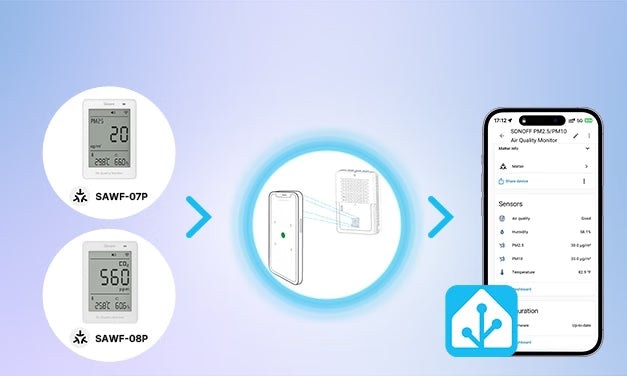
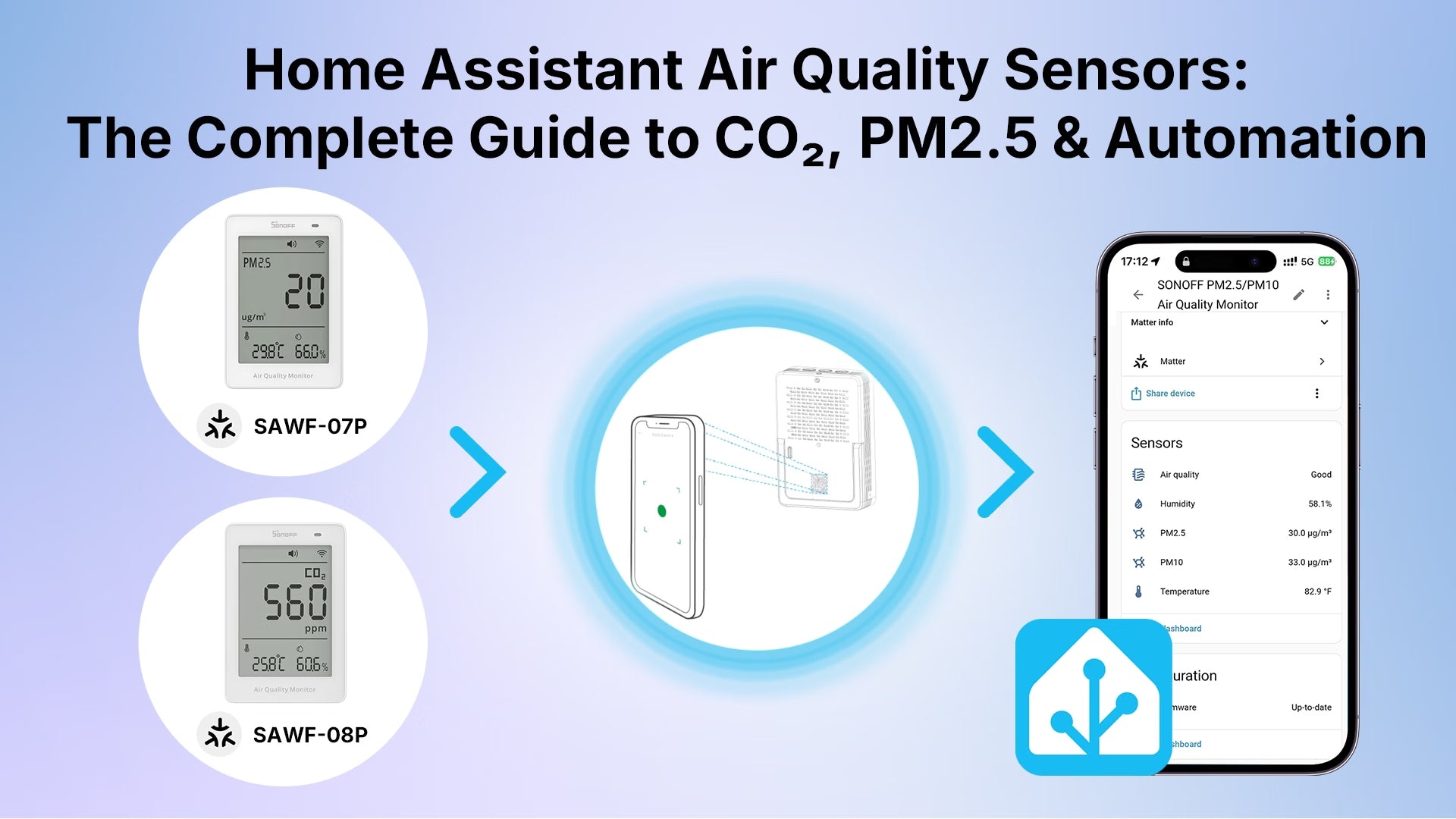
SONOFF AirGuard PM (SAWF-07P) and AirGuard CO₂ (SAWF-08P) offer real-time monitoring, fast responses, and Matter over Wi-Fi setup for Home Assistant dashboards and automations. Both have a 3.73-inch LCD with large numbers, a corner indicator that changes color with air quality, sound and light alarms, and physical controls for alarm settings and temperature units.
AirGuard PM (SAWF-07P)
Priced at $39.90, this 4-in-1 monitor measures PM2.5, PM10, temperature, and humidity. It supports switching between PM2.5/PM10 detection modes and selecting temperature units. Its laser particulate sensor has typical accuracy of ±10 µg/m³ (0–100 µg/m³ range) and ±10% (100–500 µg/m³ range).
It suits monitoring cooking fumes, candle smoke, traffic pollution, and wildfire particles, particularly in homes with pets or young children and locations near heavy traffic or affected by wildfires.
AirGuard CO₂ (SAWF-08P)
At $49.90, this 3-in-1 model measures CO₂, temperature, and humidity, with selectable temperature units. Its NDIR CO₂ sensor has typical accuracy of ±50 ppm ±5% for assessing indoor ventilation.
It suits bedrooms, home offices, classrooms, nurseries, and other enclosed spaces. Consider it when you want fresh-air reminders, share a closed room with several people, or experience afternoon headaches or brain fog while working at home.
|
Feature |
AirGuard PM2.5/PM10 |
AirGuard CO2 |
|
Model |
SAWF-07P |
SAWF-08P |
|
Detectable Metrics |
PM2.5/PM10/Temperature/ Humidity |
CO2/Temperature/ Humidity |
|
MCU |
ESP32-D0WDR2-V3 |
ESP32-D0WDR2-V3 |
|
Protocol |
Matter-over-Wi-Fi |
Matter-over-Wi-Fi |
|
Power |
5V1A, USB-C |
5V1A, USB-C |
|
Display |
3.73″ LCD |
3.73″ LCD |
|
Dimensions |
70 × 103 × 26 mm |
70 × 103 × 26 mm |
|
Weight |
127.6g |
101g |
|
Casing Material |
PC+ABS |
PC+ABS |
|
T/H Accuracy |
±0.5°C, ±3% |
±0.5°C, ±3% |
|
CO₂ Accuracy |
— |
±50 ppm ±5% |
|
PM Accuracy |
±10 µg/m³ (0–100 µg/m³) ±10% (100–500 µg/m³) |
— |
|
Temp. & Humi. Calibration |
✅ |
✅ |
|
Sound & Light Alarm |
✅ |
✅ |
|
Installation |
Stand |
Stand |
Both monitors connect directly through Home Assistant's Matter integration using the QR code on the back. For setup details, consult the guide How to add Matter devices to Home Assistant?
Choose the CO₂ model for ventilation monitoring and the SONOFF AirGuard PM2.5/PM10 (SAWF-07P) for particles and purifier control. Using both gives broader indoor air quality coverage.
Temperature and humidity alternatives
If particles and CO₂ are not your priority, a dedicated temperature and humidity sensor may be more suitable. SONOFF's Home Assistant-compatible options include:
- SNZB-02DR2: Zigbee, 3.6" LCD, with stand placement or hook hanging.
- SNZB-02D: Zigbee, 2.5" LCD, with stand mounting.
- SNZB-02WD: IP65-rated Zigbee model with a 2.2" LCD for humid and wet indoor environments.
- SNZB-02LD: Zigbee, 2.2" LCD, and a 1.5 m waterproof probe for liquids and enclosed spaces inaccessible to the body. It measures temperature only, not humidity.
- SNZB-02P: Compact, screenless Zigbee model with up to 4-year battery life.
- SNZB-02B: Screenless Zigbee model measuring only 27.8 mm wide and 20 mm thick for narrow spaces.
Further setup information is available in Home Assistant Temperature & Humidity Sensor Setup and Automation Guide.
Connecting sensors to Home Assistant
The pairing method depends on the protocol:
- Matter: Add the device through Home Assistant's Matter integration.
- Zigbee: Pair through ZHA or Zigbee2MQTT.
- Wi-Fi: Use the manufacturer's integration or a compatible HACS integration.
After pairing, sensor entities can populate dashboards and history charts or control purifiers, fresh-air systems, HVAC equipment, exhaust fans, dehumidifiers, and notifications using your chosen thresholds.
Practical air quality automations
Ventilate when CO₂ rises
High CO₂ generally points to insufficient ventilation. Automated airflow control is useful in bedrooms, offices, study rooms, nurseries, and meeting rooms.
Suggested CO₂ thresholds:
|
CO₂ Level |
Air Quality |
Recommended Action |
|
< 800 ppm |
Excellent |
No action needed |
|
800–1000 ppm |
Good |
Ventilation recommended |
|
1000–1500 ppm |
Poor ventilation |
Turn on the ventilation |
|
> 1500 ppm |
Very Poor |
Ventilate immediately |
- When CO₂ > 1000 ppm, turn on the ventilation fan / HRV / HVAC, then optionally send a notification.
- When CO₂ < 800 ppm, turn ventilation off.
As a general guide, below 800 ppm is excellent; 800–1000 ppm is good; 1000–1500 ppm calls for better ventilation; and above 1500 ppm indicates poor ventilation requiring immediate airing. Many Home Assistant users start ventilation above 1000 ppm.
Run a purifier when particle levels increase
Cooking, candles, fireplaces, and wildfire smoke can rapidly raise PM2.5. Purifier automation is particularly useful for kitchens, homes with pets or children, allergy sufferers, and households near busy roads or in wildfire-prone regions.
Suggested PM2.5 thresholds:
|
PM2.5 |
Air Quality |
Recommended Action |
|
0–12 µg/m³ |
Good |
No action needed |
|
12–35 µg/m³ |
Moderate |
Monitor air quality; sensitive individuals may consider an air purifier |
|
> 35 µg/m³ |
Unhealthy |
Turn on the air purifier immediately |
The EPA's 24-hour National Ambient Air Quality Standard (NAAQS) for PM2.5 is 35 µg/m³; the WHO recommends a 24-hour average no higher than 15 µg/m³.
- When PM2.5 > 35 µg/m³, run the Air Purifier for 30 min and optionally send a notification indicating elevated PM2.5 and purifier activation.
- When PM2.5 < 12 µg/m³, turn the purifier off.
A minimum run time, such as 30 minutes, helps the purifier clean the entire room. Many users choose 35 µg/m³ as their starting threshold, aligning with the EPA's 24-hour standard; consider a lower threshold for households with young children, allergy sufferers, or people with asthma.
Clear excess humidity
Bathroom exhaust automation can limit post-shower condensation and mold risk. It is also useful in basements, laundry rooms, and poorly ventilated spaces.
Suggested humidity thresholds:
|
Relative Humidity |
Air Status |
Recommended Action |
|
< 30% RH |
Too dry |
Consider a humidifier |
|
30 – 50% RH |
Ideal |
No action needed |
|
50-60% RH |
Normal |
Monitor closely |
|
> 60% RH |
High humidity |
Turn on the exhaust fan or dehumidifier |
- When humidity > 60% RH, start the bathroom exhaust fan and optionally send a notification.
- Once humidity falls below 50% RH, wait 10 minutes to clear residual moisture, then stop the fan.
The EPA recommends indoor relative humidity below 60%, ideally between 30% and 50%.
Respond to wildfire smoke
Wildfire seasons are growing longer and more severe, particularly in the western United States, Canada, and Australia. Even with windows closed, fine particles can enter through ventilation and small air leaks. Automatic responses can help reduce indoor exposure.
- When indoor PM2.5 rises rapidly, start the purifier, switch HVAC to Recirculation Mode, and send an air quality alert.
- Optionally close windows during severe smoke events if smart window actuators are available.
This approach suits wildfire-prone locations such as California, the Pacific Northwest, Canada, and Australia, as well as homes near forests or grasslands and areas with seasonal smoke.
Combine indoor readings with outdoor data from AirNow or a local government air quality service to enable warnings before smoke substantially affects indoor conditions.
The U.S. EPA's Wildfires and Indoor Air Quality (IAQ) guide offers additional advice on portable air cleaners, HVAC recirculation, and keeping doors and windows closed during wildfire events.