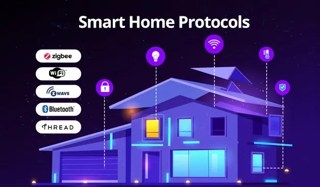
Most smart homes develop gradually rather than follow a single plan. Zigbee bulbs, Z-Wave switches, older 433 MHz plugs, Wi-Fi cameras and sometimes a wired KNX installation end up sharing the same home. Thread adds another network to that mix; Homey brings their devices together in one automation system.
How Thread, Zigbee and Wi-Fi share the air
Thread manages routes between its devices and repairs connections within its own mesh. Unlike older protocols that often depend on a hub to direct traffic or recover connections, it maintains network stability itself. Homey provides the border router connection and processes automations rather than continually managing wireless routes.
Thread, Zigbee and Wi-Fi all use the busy 2.4 GHz band. Thread and Zigbee share the low-power 802.15.4 radio standard, whereas Wi-Fi uses more power to support higher data throughput. Despite sharing spectrum, these are separate networks with their own security, routing and traffic management; they do not communicate directly.
Homey manages Zigbee through its internal radio and coordinates Thread through its Thread stack and border router functionality. Wi-Fi supports cameras and cloud connectivity. By translating between networks, Homey lets a Wi-Fi camera’s motion detection activate a Zigbee light or a Thread lock without a delay noticeable to the user.
Channel planning matters because stronger Wi-Fi signals can overwhelm lower-power networks. Setting your Wi-Fi router to channel 1 or 6 leaves the upper part of the band available for less congested Zigbee and Thread channels, helping prevent packet loss and maintain responsiveness. Extremely dense wireless environments can still suffer interference, but normal homes generally work well with appropriate placement and channel selection.
Pairing Thread with Z-Wave
Z-Wave uses sub-GHz frequencies, so it does not compete with Thread or Wi-Fi for airtime. This frequency separation lets the networks operate without degrading one another’s signals.
For fixed equipment such as in-wall switches and dimmers, Z-Wave remains a strong option. Thread supplies a fast, battery-efficient network for modern Matter accessories. Their range characteristics also complement each other: Z-Wave’s lower frequency travels through thick concrete walls and floors more effectively, while Thread offers higher bandwidth in open spaces. Together, they can cover layouts that challenge a single protocol.
Homey can use a Z-Wave door sensor to activate a Thread wall plug, or a Thread button to dim Z-Wave lights. Thread does not make Z-Wave obsolete; existing installations and certain device categories will keep it relevant for a long time.
Adding wireless flexibility to KNX
KNX is a wired fieldbus system with decades of reliable use. Thread serves a different purpose: it extends connectivity to places where wiring is impractical rather than replacing that infrastructure.
In a home where KNX controls lighting, blinds and HVAC, Thread can add battery-powered sensors and wireless switches. Homey combines both systems, allowing a Thread window contact sensor to influence KNX heating logic or a KNX motion sensor to activate a Thread plug.
For a Thread sensor to control KNX equipment, Homey receives the sensor event and sends commands to the KNX actuators through the KNX bridge. Thread’s wireless IP network and KNX’s wired fieldbus address different layers, making coexistence more likely than replacement.
Keeping useful 433 MHz devices
Basic 433 MHz remotes and switches offer long range at low cost, but generally lack security features and do not report their status to the controller. They usually transmit without confirming delivery. Thread, by contrast, communicates in both directions and acknowledges receipt.
You can retain older devices for tasks they still handle well while introducing Thread where its capabilities matter. Reserve Thread for critical equipment such as locks or heaters, and leave simpler jobs to existing 433 MHz sensors.
A 433 MHz button can also launch a Thread lighting scene indirectly: Homey receives its signal and triggers Flows that act on Thread devices. That allows gradual upgrades rather than wholesale replacement.
Building automations across networks
With Homey coordinating the system, devices can participate in the same automations regardless of their protocol. Once added, Thread/Matter devices work like other devices with capabilities; they do not require a separate approach to automation.
Thread and Zigbee have independent stacks and can run together on Homey without conflict under normal conditions. When protocols are used appropriately, stability depends more on device and radio quality than on how many protocols are present.
Homey supports Zigbee, Z-Wave, Matter, Thread, KNX, 433 MHz, Wi-Fi, Bluetooth and Infrared. It also integrates with Amazon Alexa, Google Home and Apple Home, allowing devices from different technologies and platforms to work in a shared setup.
Thread therefore adds a modern, low-power IP mesh without requiring you to discard working hardware. Homey and its Flow engine coordinate the devices, leaving you to design scenarios that use each network where it fits best.
Key terms
- Hybrid smart home: A home that combines multiple protocols and technologies under a central controller such as Homey.
- Wireless coexistence: Multiple wireless systems operating in the same space without unacceptable interference.
- Radio spectrum: The available range of radio frequencies, with different protocols using different portions.
- Trigger: An event that starts an automation, whatever protocol the originating device uses.
- Actuator: A device that carries out an action, such as switching on a light or moving a blind, regardless of protocol.
- Orchestrator: The system coordinating device behavior—in this setup, Homey and its Flow engine.
- Legacy devices: Older equipment, including 433 MHz devices, that remains useful but may lack modern security or features.