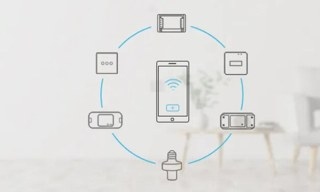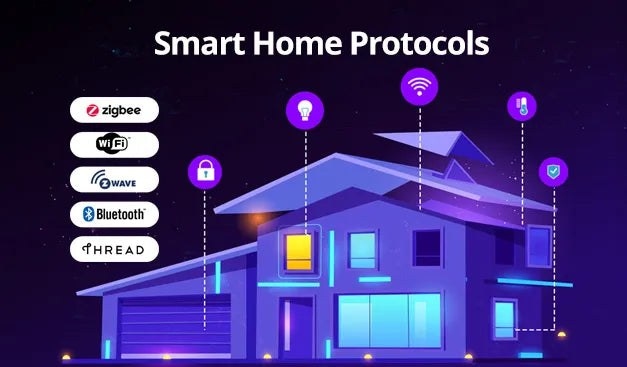
Smart home communication standards let devices exchange information and work together. Choosing between Bluetooth, Wi-Fi, Z-Wave, Zigbee and Thread involves balancing range, power use, bandwidth, reliability and compatibility. Matter adds a way to connect products across ecosystems.
Bluetooth: an accessible starting point
Bluetooth supports local control and data transfer, using technology already familiar from wireless headphones, mice and keyboards. Some Philips Hue lighting products support it, letting users connect a bulb to a phone and adjust its color or brightness in the Philips Hue app without additional equipment. Compatible Amazon Echo devices can also pair with these lights for voice-controlled switching and brightness adjustment.
Because Bluetooth operates locally, lights can remain controllable without internet access. Some manufacturers also allow operation without a cloud account. Smart devices commonly use Bluetooth low-energy to minimize battery consumption.
The main limitations are short range and limited scalability. Control may effectively be restricted to the same room, and the Alexa-enabled light example offers little beyond basic lighting functions.
Wi-Fi: bandwidth and convenience, with caveats
Wi-Fi connects devices through a router, providing internet access for remote monitoring and control. Its high bandwidth, fast transmission and broad coverage suit security cameras and other video devices. Since many homes already have Wi-Fi, extra infrastructure is often unnecessary.
However, inexpensive routers supplied by internet providers may support only a dozen or so wireless connections. Adding lights, switches and sensors alongside televisions, phones and laptops can overwhelm them. Wi-Fi also consumes relatively high power, and congestion—such as heavy 4K Netflix streaming—can delay lighting commands.
Cloud dependence is another concern. The source describes tp-link replacing locally controlled Wi-Fi smart plugs with versions that require internet communication. In a cloud-controlled setup, a phone command travels to a remote server before returning to the switch. This can slow responses and give the provider a record of switching activity. Internet-connected Wi-Fi devices are also more exposed to hacking or takeover.
Wi-Fi remains widely accessible, but device selection and router capacity affect reliability and performance.
Z-Wave: local mesh networking with longer reach
Z-Wave was developed specifically for smart homes, unlike Bluetooth and Wi-Fi. Its introductory description emphasizes low power, high bandwidth, reliability and interoperability, with support for up to 232 devices. In practical bandwidth terms, however, its roughly 100 kb/s capacity is much lower than Wi-Fi or Bluetooth.
Mains-powered Z-Wave devices can relay messages through a mesh until they reach the hub or controller. Adding these routing devices extends coverage and strengthens the network. For example, switches in other rooms can carry a network outward from automation equipment in a basement.
Battery-powered sensors use little energy and can commonly last over a year on one battery. Operating around the 900 MHz radio spectrum reduces interference from other radio devices and helps signals pass through walls and floors.
The network operates locally, independently of Wi-Fi and internet access, with encrypted device messages. These characteristics improve security and preserve operation during internet outages. Limited bandwidth makes Z-Wave unsuitable for video or audio streaming, but sufficient for small messages from motion sensors, temperature sensors and light switches.
Certification, cost and controllers
The Z-Wave Alliance requires membership before a company can seek certification, which is necessary to use the Z-Wave logo. Certification is intended to ensure that certified products work together. Its cost can discourage smaller manufacturers and increase consumer prices compared with Bluetooth, Wi-Fi or Zigbee alternatives. Z-Wave is also proprietary.
Phones and laptops do not include Z-Wave, so devices need a separate hub or controller. Alternatively, a Z-Wave USB dongle can connect them to Home Assistant on a mini PC or Raspberry Pi, potentially reducing costs while allowing more customization and control.
A Z-Wave 800 series USB dongle such as SONOFF’s Z-Wave Dongle Plus is presented as a way to build a local network with improved performance, range and device capacity. Users satisfied with an existing Z-Wave installation have no reason to abandon it.
Zigbee: a broad ecosystem of low-power devices
Zigbee is a low-power, short-range wireless protocol supporting up to 65,000 devices through its network topology. As with Z-Wave, nearly every mains-powered device can strengthen the mesh. Communication is local, encrypted and independent of Wi-Fi or internet availability.
Maximum throughput is about 250 kb/s—two and a half times Z-Wave’s rate, but still unsuitable for audio or video. Zigbee has an alliance and certification program, though the source regards its certification as less strict than Z-Wave’s. Its 2.4 GHz operation can also encounter Wi-Fi interference.
Dating back to the 90s, Zigbee has a long history and a large selection of sensors, switches, smart plugs and controllers. SONOFF’s ecosystem includes hubs, routers and end devices for expanding a smart home network.
Thread: an IPv6 mesh designed for resilience
Thread is a newer, low-power wireless protocol based on IPv6, designed for secure, stable connections among multiple devices. The source views it as an improved Zigbee-like approach: it uses the same radio hardware, 2.4 GHz spectrum and 250 kb/s throughput, along with an encrypted, low-power mesh. A certification program is intended to support interoperability.
A key distinction concerns network control. Z-Wave and Zigbee allow only one active hub, controller or coordinator per network. If that unit becomes unavailable, the network goes down; replacing a broken hub requires reconnecting devices.
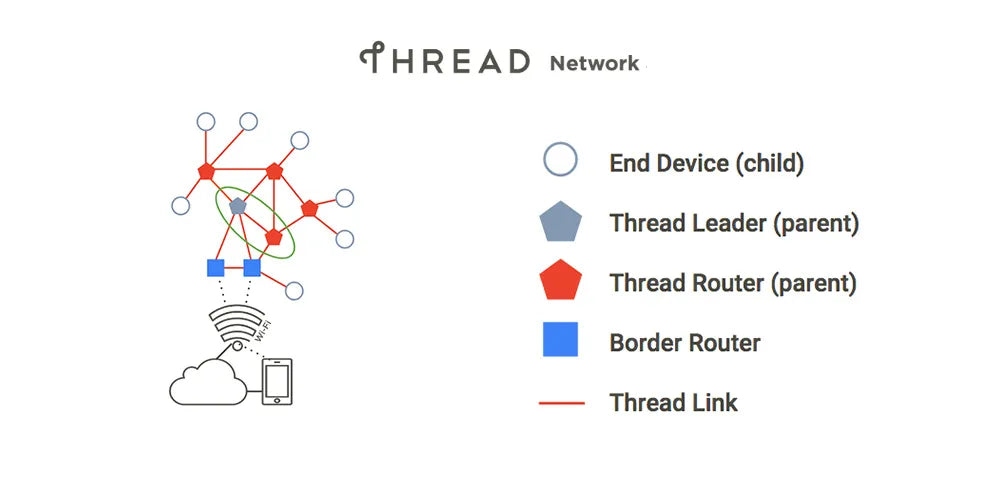
Thread permits multiple routers, with one elected as leader. If that leader fails or switches off, another router can take over, improving resilience. Thread devices can also switch off their radios when unnecessary. The source suggests that a comparable device lasting a year on Zigbee might last two or three years on Thread.
IPv6 addressing should allow Thread devices to communicate with Wi-Fi smart devices and other services on the home network or internet. Thread requires a Thread Border Router.
Adoption is growing, but some platforms still have early implementation problems and device choice remains smaller. A multi-protocol dongle that serves as both a Zigbee coordinator and Thread radio interface (RCP) offers one approach to the limited ecosystem. For example, the SONOFF Zigbee & Thread PoE Dongle Max can operate as a Thread RCP for Home Assistant to manage Thread networks.
Matter: connecting smart home ecosystems
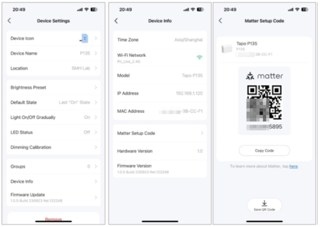
Introduced in the source as the latest smart home protocol, Matter is more specifically described in its comparison as an open standard rather than a protocol. Developed by the Connectivity Standards Alliance (CSA) with support from Apple, Google, Amazon and Samsung, it aims to reduce fragmentation between brands and platforms.
- Cross-platform support: Matter works across Apple Home, Google Home, Amazon Alexa and SmartThings.
- Security and responsiveness: It uses end-to-end encryption and local operation.
- Transport options: It runs over Wi-Fi, Thread or Ethernet. Thread supports low-power, battery-operated devices; Wi-Fi serves high-bandwidth devices, while Bluetooth handles initial pairing.
- Existing equipment: Some Zigbee devices can be updated for Matter support.
SONOFF products with native Matter support
The following products can join a Matter network directly and interact with other Matter-certified devices across supported ecosystems:
- MINIR4M WiFi Smart Switch
- M5 Matter Smart Wall Switch
- MINI DUO 2-Gang Matter Over WiFi Smart Switch
- Smart Roller Shutter Switch MINI-RBS
- MINI Dry Wi-Fi Smart Switch MINI-D
- Basic Gen5 Matter Over WiFi Smart Switch
- PM2.5/PM10 Matter Over Wi-Fi Air Quality Monitor SAWF-07P
- CO2 Matter Over Wi-Fi Air Quality Monitor SAWF-08P
These are examples rather than a complete list.
Matter controllers and bridges
The source identifies these products as Matter Hubs, or Matter controllers, for managing other Matter devices:
- SONOFF NSPanel Pro Smart Home Control Panel
- SONOFF Zigbee Bridge Ultra
- SONOFF iHost Smart Home Hub
NSPanel Pro, iHost and Zigbee Bridge Ultra can also act as Matter Bridges. This lets some SONOFF devices without native Matter support interact with Matter-certified products and join automations without replacing existing hardware.
| Protocol | Range | Power Consumption | Interoperability | Best For | Key Features |
|---|
| Wi-Fi | Unlimited | High | Vendor-dependent | High-bandwidth devices (cameras, streaming) | Direct cloud access, high-speed, but power-hungry |
| Bluetooth | ~10m | Low | Limited | Short-range device pairing (locks, sensors) | Low energy (BLE), mainly for initial pairing |
| Zigbee | ~10-100m | Low | Zigbee Alliance certified | Smart bulbs, sensors, switches | Mesh network, requires hub |
| Z-Wave | ~30-100m | Low | Z-Wave Alliance certified | Security systems, automation | Mesh network, lower interference |
| Thread | ~10-30m (per node) | Very Low | Thread Group certified | Battery-powered smart devices | Low-power mesh, future-proof |
| Matter | Depends on underlying protocol | Depends on underlying protocol | Cross-ecosystem (Matter-certified devices) | Interoperable smart home devices | Works over Thread, Wi-Fi, and Ethernet |
Which option fits your home?
- Simple installation: Wi-Fi avoids a separate hub, provided the router is not overloaded.
- Low power and reliability: Zigbee or Thread are suitable choices.
- Long range: Z-Wave is the suggested option.
- Future interoperability: Consider Matter-certified devices, ideally over Thread/Wi-Fi.
No option is universally best. Matter is presented as especially promising for future interoperability, while Zigbee, Z-Wave and Wi-Fi retain useful roles. Matter does not entirely replace Zigbee or Z-Wave; instead, it offers a more unified experience, and many future Zigbee devices are expected to include Matter compatibility.
SONOFF is developing additional Matter-certified products for Apple Home, Google Home, Amazon Alexa and Samsung SmartThings. Its planned expansion includes smart switches and other IoT devices intended to improve cross-platform compatibility.